

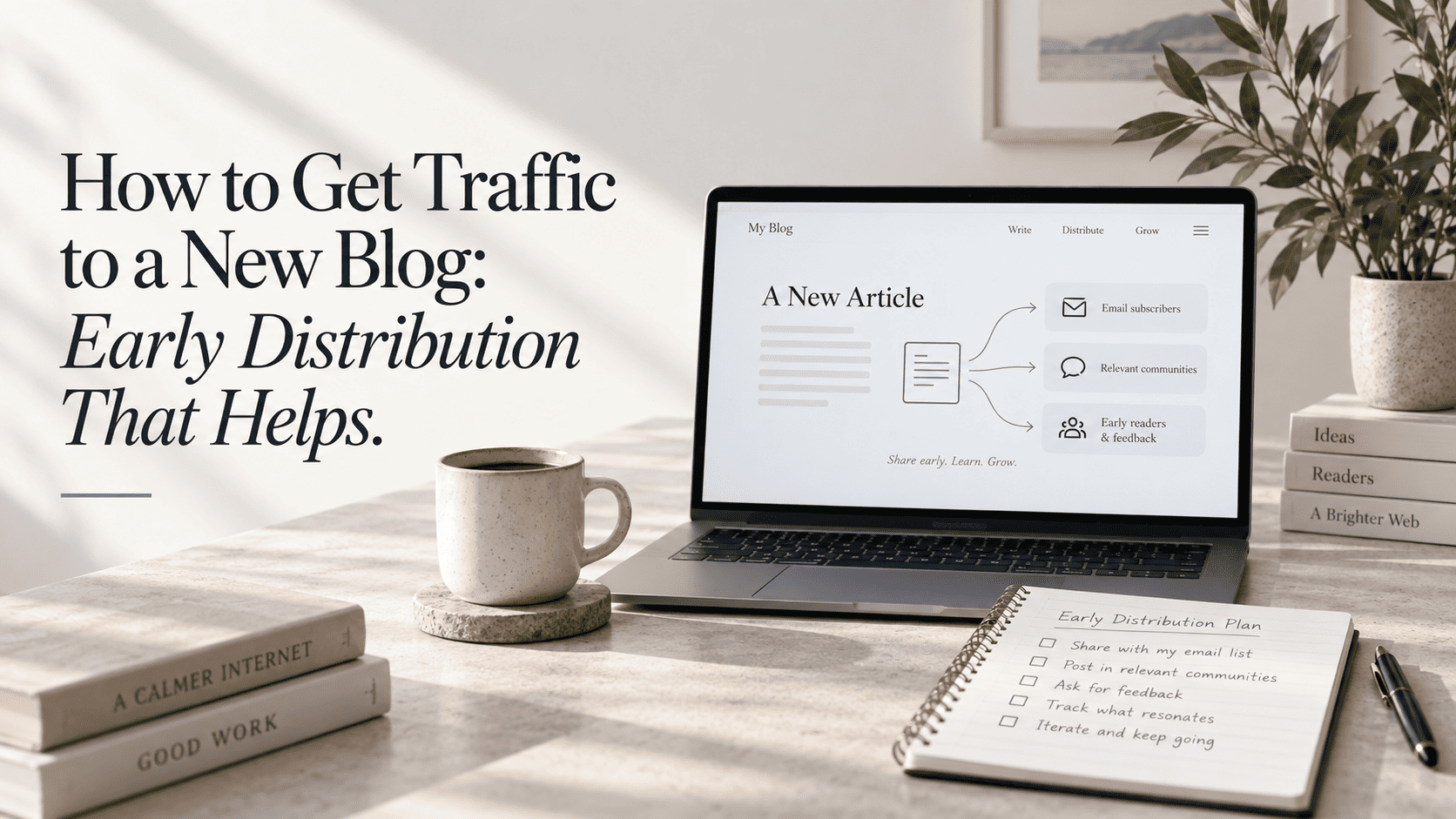


Early distribution is how a new blog earns its first relevant readers while search visibility is still developing. It works when the message fits the channel and gives people a useful reason to visit. It fails when the same promotional link is dropped into every community, regardless of audience, timing, or rules.
The objective is not to manufacture traffic. It is to learn which problems attract the right readers, explain those problems helpfully where people already gather, and make the full article worth the click. That creates a repeatable editorial loop rather than a one-off promotional blast.
Choose readers before channels
Start with a single article and describe the reader who needs it. What is the concrete question? What would that person need to understand before acting? Where do they already ask for help, compare options, or save resources? The answers should determine the distribution channel, not the other way around.
| Channel | Use it for | Avoid |
|---|---|---|
| Useful updates for people who opted in | Unrelated promotions | |
| Communities | Answering an existing question with context | Dropping links without contribution |
| Social posts | One clear insight, example, or visual | Generic announcements |
| Collaborations | Shared expertise and relevant resources | Forced exchanges with no reader value |
Good to know
Referral visits can reveal whether a message reaches the right people, but they do not guarantee Google rankings.
- Track the source and article promoted.
- Review engaged visits and reader responses.
- Repeat channels that bring relevant readers.
Best strategy: earn attention with a useful answer before asking for a click.
Build a distribution brief for every article
Before sharing, create a short brief. Write the article’s reader question, the strongest useful insight, one example that can stand alone, two appropriate channels, and the action you want the reader to take next. This prevents a common error: trying to write a social post, a community answer, and an email using the same vague sentence.
For example, a post about indexing a new blog can become a concise answer about checking an unintended noindex directive. The full article can then explain discovery, crawling, indexing, sitemap submission, and URL Inspection. The short form should be useful on its own; the full guide should add depth rather than repeat the teaser.
Use communities as conversations, not placements
Communities have context, norms, and moderators. Read the rules first. Search for existing questions that your article can genuinely clarify. When you contribute, lead with the answer, the caveat, or the process—not the link. Link only when it gives the reader a more complete resource and the rules permit it.
This approach takes more effort than posting the same announcement everywhere. It is also more useful for finding real language from readers. Questions, objections, and follow-up comments can reveal gaps in an article. Record those gaps and update the page when you have a meaningful improvement to make.
Create a weekly distribution loop
- Publish one focused article for a defined reader question.
- Extract two useful, channel-appropriate summaries.
- Share only where the audience and community rules fit.
- Record source, visits, engagement, replies, and recurring questions.
- Improve the article when readers expose a genuine gap.
- Link readers to the next relevant guide, not a generic homepage.
One weekly loop is enough for a new blog. Consistency matters more than a large volume of low-context mentions. A small number of thoughtful distributions also makes it easier to understand what worked. If several sources point to the same page but readers leave immediately, revisit the promise in the distribution message and the opening of the article.
Measure quality, not just volume
| Signal | What it may indicate | How to use it |
|---|---|---|
| Relevant replies | The topic met a real question | Turn recurring concerns into clearer sections |
| Engaged visits | The message and page matched reasonably well | Test a similar angle for another distinct question |
| Quick exits | The promise or page may be mismatched | Review the opener and the audience fit |
| Repeat referrals | A channel may fit the audience | Maintain a useful, non-spammy cadence |
Good to know
No single metric proves that a distribution tactic works. Traffic volume, clicks, and follower counts are incomplete without relevance and reader response.
- Compare articles with similar purposes.
- Use analytics as directional evidence.
- Do not set universal traffic thresholds.
Best strategy: favor useful reader signals over vanity numbers.
Connect distribution with the site structure
Distribution is more effective when a reader can continue naturally. A traffic pillar can give the overall 90-day plan. A technical indexing guide can answer why a page is not discoverable. A timeline article can explain why no universal traffic date exists. Link to the next specific answer when it helps, and avoid adding links that merely inflate a count.
Before promoting a page, check the page itself. Is the title accurate? Is the opening direct? Does the article explain the mechanism before recommending action? Are claims supported and proportionate? Distribution cannot compensate for a thin article, a blocked URL, or a page that does not answer the query it promises to answer.
What to avoid
Do not buy artificial engagement, automate community posts, publish comment links with no context, or treat every contact as a prospect. These tactics can waste trust and make it harder to tell whether the content actually helps. Avoid claims that a certain number of shares, visits, or backlinks will trigger rankings. Google does not publish such thresholds.
Also avoid making every article a promotion for the same service or landing page. Supporting articles need their own editorial job. A reader who arrives for an indexing checklist should receive the checklist first; any relevant next step should be secondary and clear.
A practical first-month plan
Week one: publish a focused resource and make its on-page explanation complete. Week two: share two distinct summaries with appropriate audiences. Week three: review replies and behaviour, then improve a real gap. Week four: publish the next supporting article that answers a related but different question. This approach builds a small, usable cluster instead of a pile of disconnected promotional posts.
Plan the next stages: Use the pillar roadmap to connect early distribution with indexing, measurement, and the full 90-day publishing cycle.

Bottom line
Early distribution helps a new blog find relevant first readers and sharper editorial insight. It does not promise indexing, rankings, or a fixed traffic outcome. Use a repeatable system: know the reader, contribute before linking, measure quality, and improve the page based on evidence.