

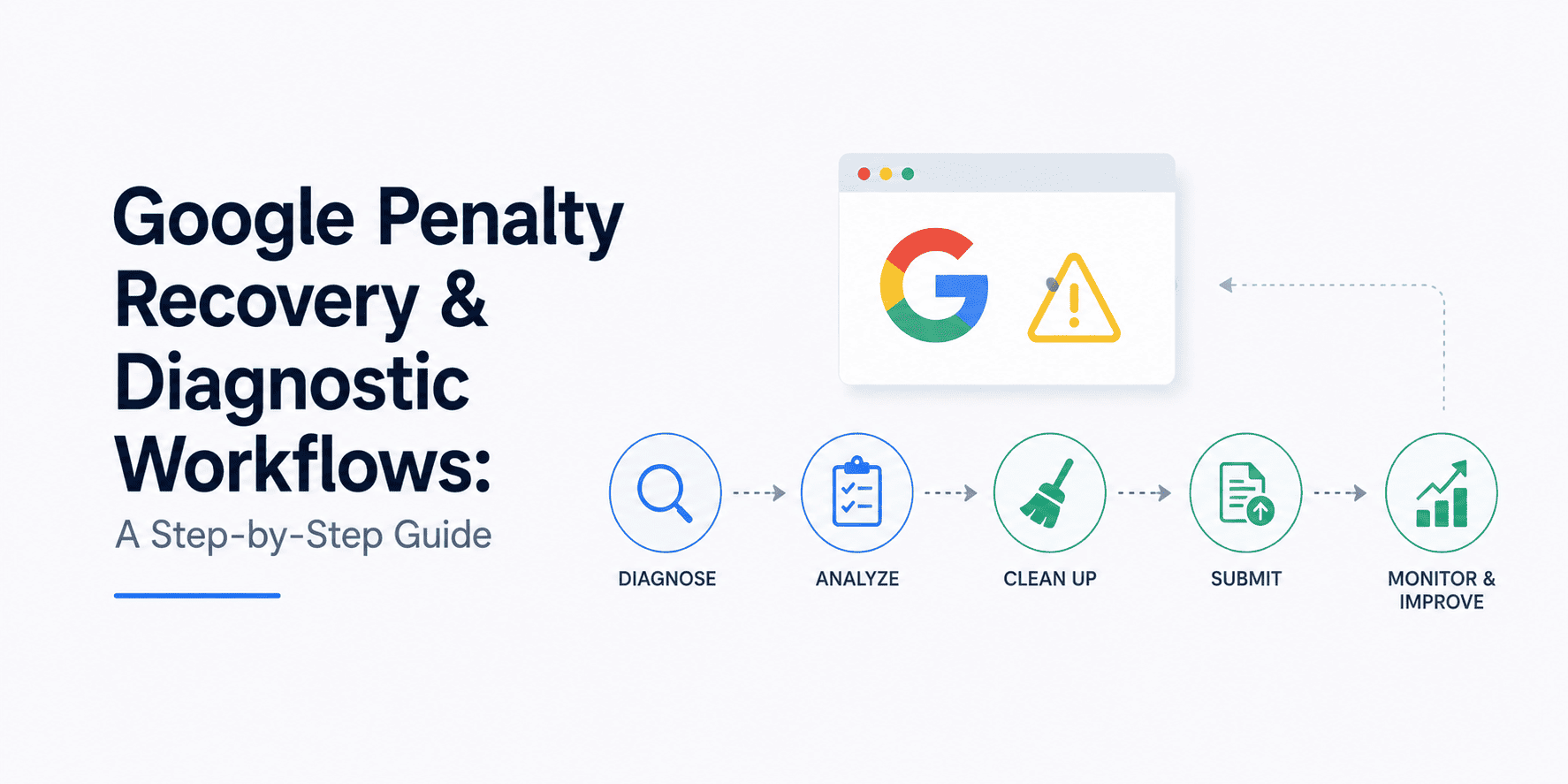


Google penalty recovery begins with diagnosis, not with automatic link removal. A traffic decline can follow technical changes, indexing problems, competition, seasonality, changes to search results, a manual action, or other causes. Start with evidence before making irreversible changes.
Start with Search Console
Check the Manual actions report in Google Search Console. A manual action is an explicit notice that Google has identified a policy issue. If there is no manual action, do not assume that a silent algorithmic penalty explains the decline; compare Search Console data with releases, technical changes, indexing coverage, and search-result changes.
Good to know
A manual action is explicit evidence in Search Console; a traffic drop without one still needs a broader diagnosis.
- Check the Manual actions report first.
- Compare clicks, impressions, and affected page groups.
- Record releases, indexing changes, and search-result changes.
Best strategy: verify the evidence before choosing a remedy.
Manual actions and unexplained declines
The comparison table below separates an explicit manual action from a performance decline that still needs investigation.
| Question | Manual action | Unexplained performance decline |
|---|---|---|
| Where to look | Search Console Manual actions report | Search Console data, technical changes, indexing, and search context |
| Notice | Explicit Search Console notification | No single notice proves an “algorithmic penalty” |
| First response | Fix the cited violation and document remediation | Diagnose causes; do not assume links are responsible |
| Reconsideration request | Relevant after resolving a manual action | Not a general appeal for traffic drops |
Good to know
A table can guide triage, but a performance decline alone does not prove an algorithmic penalty.
- Use the report as the source of truth for manual actions.
- Separate cited violations from observed performance changes.
- Use reconsideration only after resolving a manual action.
Best strategy: match the response to the evidence, not the label.
Build a diagnostic timeline
- Mark the first sustained change in clicks, impressions, and average position.
- Check whether affected pages were changed, redirected, deindexed, or blocked from crawling.
- Compare affected queries, devices, countries, and page groups rather than relying on a sitewide average.
- Record relevant releases and business changes as timing context, not proof of causation.
Good to know
Sequence matters more than a single sitewide chart when you are identifying the cause of a sustained decline.
- Mark the first sustained change.
- Segment by page, query, country, and device.
- Compare it with releases, crawl events, and indexing changes.
Best strategy: keep a dated evidence log and test plausible causes.
Review links proportionately
Review links because they are relevant to the site’s history, not because a third-party score crossed a fixed cutoff. Look for clear evidence of manipulative patterns: paid links passing ranking credit, large-scale exchanges created mainly to influence rankings, hacked or injected links, or low-value placements with repeated commercial anchors. Context, purpose, and the broader pattern matter.
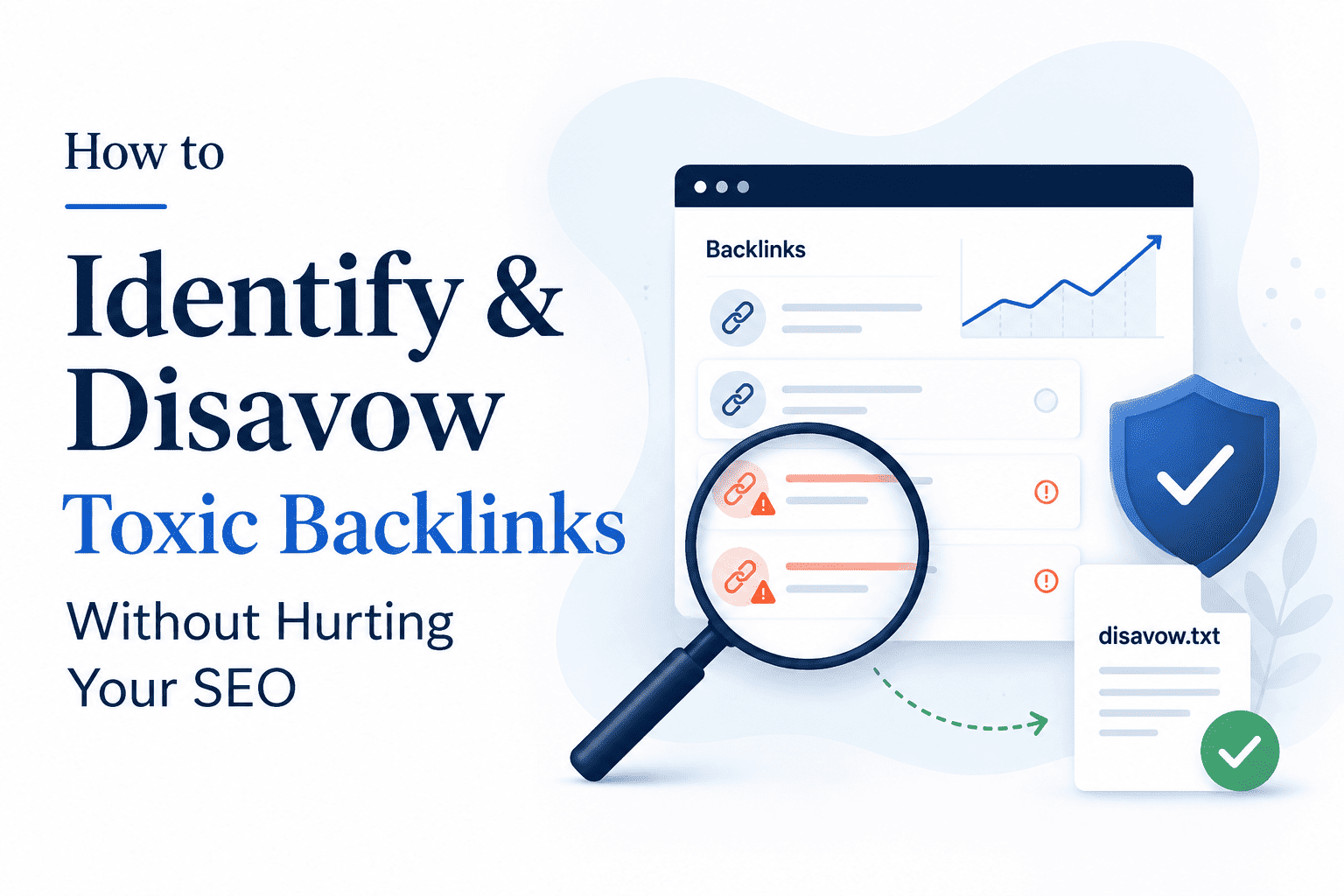
Do not create new links merely to “dilute” an anchor-text percentage. Google publishes no universal safe ratio. Use the embedded guide below for a focused framework on identifying and disavowing toxic backlinks.
Good to know
Third-party metrics can support investigation, but they do not define a Google risk threshold.
- Review the purpose and placement of each link.
- Check whether commercial anchors repeat across placements.
- Document whether a wider pattern is manipulative or merely low quality.
Best strategy: assess link context and patterns, not a single score.
Use the Disavow Tool cautiously
Google describes the Disavow Tool as an advanced feature. It is not a routine response to ordinary low-quality links, and incorrect use can affect performance. Consider it only when there is a substantial pattern of artificial, spammy, or low-quality links that could plausibly cause a manual action, and follow Google’s current documentation. Preserve a record of the evidence and the decision.
Good to know
The Disavow Tool is an advanced feature, not routine backlink housekeeping.
- Keep evidence of artificial or spammy link patterns.
- Do not disavow ordinary unwanted links automatically.
- Follow Google’s current documentation before submitting a file.
Best strategy: reserve disavow for substantial, plausible manual-action risk.
Responding to a manual action
When a manual action is present, resolve the underlying policy issue before requesting reconsideration. Explain what happened, what you changed, and how you will prevent recurrence. Reconsideration requests are for manual actions; they are not a general appeal mechanism for any ranking decline. Avoid promising a turnaround time or a particular outcome.
Good to know
A reconsideration request is narrowly for a resolved manual action, not for general ranking volatility.
- Fix the cited issue before requesting review.
- Describe the changes and preventive controls clearly.
- Do not promise recovery timelines or outcomes.
Best strategy: make remediation specific, documented, and durable.
Recovery plan after remediation
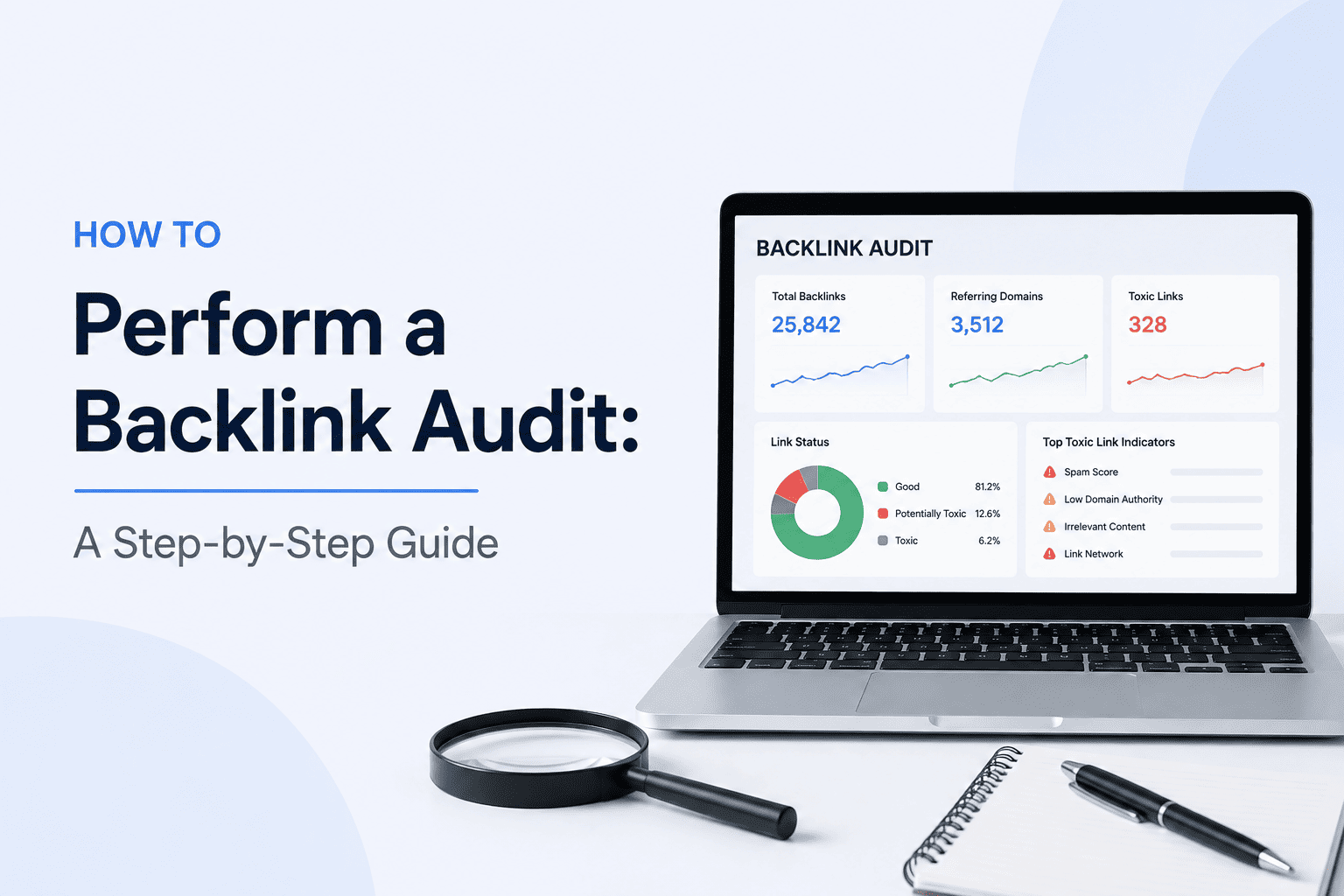
Prioritize technically sound, useful pages and links earned because they help readers: original research, tools, templates, resource pages, digital PR, and editorial partnerships. Do not treat a three-way exchange or any link topology as a recovery mechanism or guarantee. The embedded main guide below provides the wider backlink-audit process.
Good to know
Sustainable recovery comes from reader value and sound technical work, not a link formula.
- Improve pages with useful, original material.
- Earn editorial citations rather than creating link patterns.
- Use audit findings to prioritize the work that matters most.
Best strategy: combine technical remediation with genuinely useful publishing.
When to get specialist help
Get qualified SEO or legal advice when a manual action, hacked-site issue, large migration, or significant revenue loss is involved. Keep a dated log of observations, changes, and evidence so decisions can be reviewed later.
Good to know
Early expertise reduces avoidable risk in high-impact cases.
- Escalate manual actions and hacked-site issues early.
- Get migration help before technical changes compound.
- Keep a dated log that another reviewer can follow.
Best strategy: bring specialist help in before revenue or technical risk escalates.