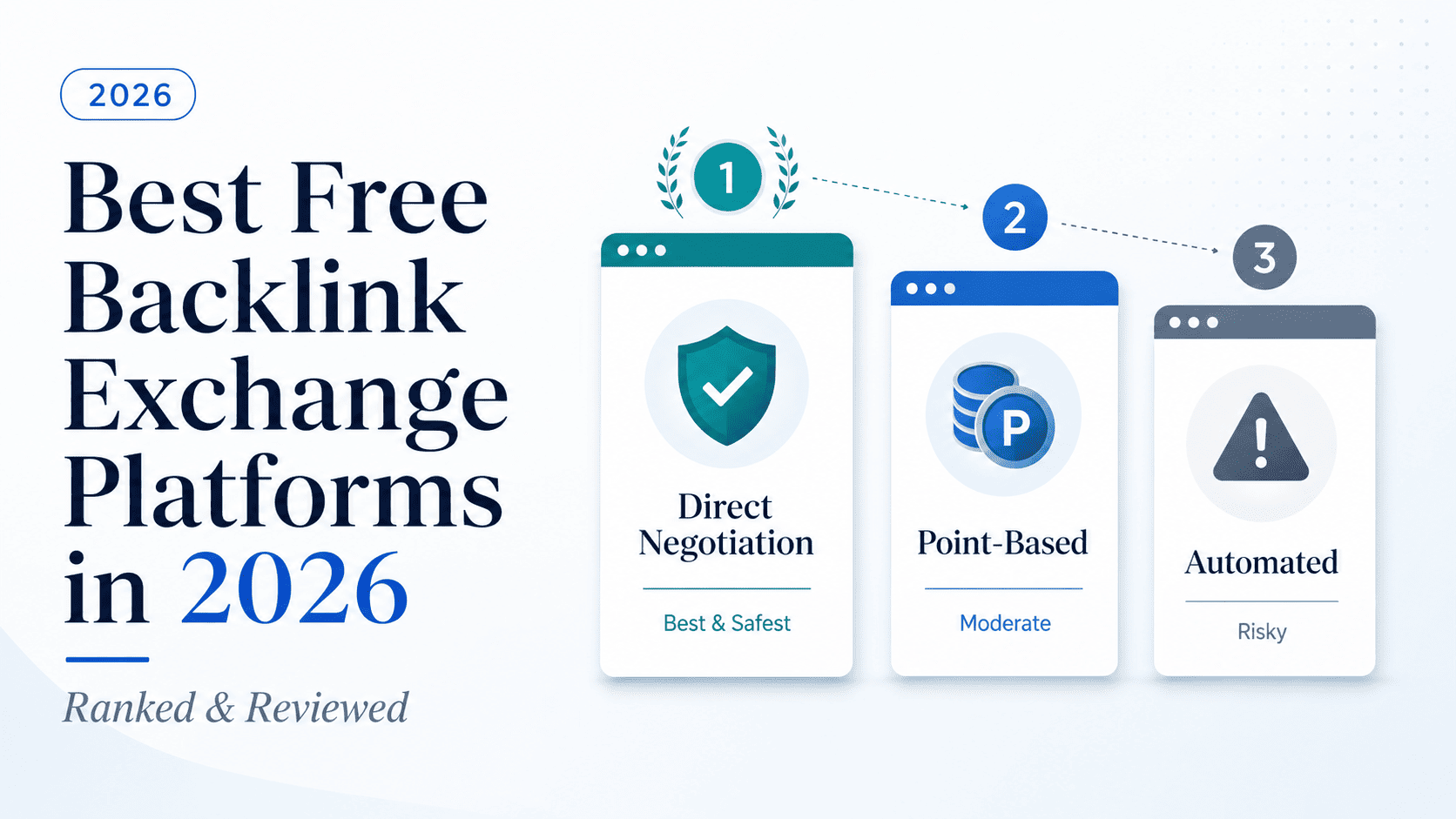
The Three Main Types of Backlink Exchange Platforms
Before comparing specific platforms, it helps to understand that "backlink exchange" isn't one single model. In 2026, most platforms fall into one of three categories, each with very different cost structures, vetting practices, and risk profiles.
(For the broader context on why this distinction matters, see our pillar guide:
 Related article · 20 Aug 2026Free Backlinks: The Complete Guide to Building Links Without Spending Money (2026)Backlinks remain one of the strongest ranking signals in SEO, but you don't need a paid link-building budget to earn them. This guide covers every legitimate free me…Read related article→
Use this comparison to decide which option fits your backlink strategy.
| Feature | BacklinkExchange.org | Point-Based Networks (e.g., KarmaLinks) | Automated Link Schemes |
|---|
| Best for |
Site owners who want direct control over placement and relevance, backed by manual vetting. |
Site owners comfortable earning or buying credits in exchange for a more structured, gamified system. |
No one — included for comparison only, not as a recommended option. |
| SEO value |
High when links are relevant and naturally placed; manual vetting keeps the overall network quality strong. |
Moderate; value depends heavily on the individual platform's vetting standards, which vary widely. |
Minimal to negative; links are inserted at scale with no editorial judgment behind them. |
| Risk |
Very low — humans vet new sites and veto low-quality ones before they join the network. |
Low to medium — some platforms vet manually, but many rely on automated metrics alone. |
Extremely high — matches the profile of a manipulative link scheme under search engine guidelines. |
| Effort |
Moderate — requires direct negotiation with partner site owners, but no points to earn or manage. |
Higher — requires earning or purchasing points before you can request placements. |
Low upfront effort, but that's part of the risk — little to no active oversight is required or possible. |
| Verdict |
Choose this when you want full editorial control, zero cost, and the lowest realistic spam risk. |
Choose this when you're willing to trade extra effort (earning/buying points) for a more structured system. |
Avoid this — the lack of vetting and control makes it a structural liability, not a shortcut. |
1. Direct Negotiation Networks — BacklinkExchange.org
Best for: Site owners who want full control over placement and relevance, with human oversight reducing spam risk
Direct negotiation platforms connect two site owners who then agree on link placement themselves — no algorithm inserting links automatically, no points to earn or buy. BacklinkExchange.org uses this model specifically, combined with manual vetting of every new site that joins, which keeps the overall pool higher quality than systems relying purely on automated metrics.
The trade-off is that direct negotiation requires a bit more active participation than a fully automated system — you're communicating with a real site owner rather than clicking a button and letting software handle placement. For most site owners, that trade-off is worth it: full editorial control means you decide exactly where and how a link appears, rather than trusting an algorithm to place it appropriately. See the full process in:
 Related article · 20 Aug 2026How Backlink Exchanges Work: A Step-by-Step Guide to Swapping Links for FreeBacklink exchanges are one of the most accessible ways to build free links, but doing them safely and effectively requires understanding the actual mechanics — from…Read related article→
2. Point-Based Networks
Best for: Site owners comfortable with a structured, gamified system and willing to earn or purchase credits
Point-based networks, such as KarmaLinks-style platforms, operate on a credit system — you typically earn points by placing links to other members' sites, then spend those points to get links placed on yours (or purchase points directly). This adds structure and a built-in incentive system, but vetting quality varies significantly by platform: some rely on manual review, but many lean on automated metrics alone, which can let lower-quality sites into the pool.
The trading friction here is real — building up enough points to get meaningful placements takes time and effort, and freemium models often gate the best opportunities behind paid credits.
3. Automated Link Schemes
Best for: Nobody, generally — included here for comparison, not recommendation
Fully automated link schemes insert links algorithmically with no human review and no webmaster control over placement or context. These systems typically operate on a paid subscription model despite offering the least oversight of the three categories. This approach falls squarely into what search engines classify as a manipulative link scheme, since links are generated and placed at scale without genuine editorial judgment behind them.
We're including this category for completeness and comparison — not as a recommendation. The extremely high spam risk here isn't a minor drawback; it's a structural feature of how these systems work, and using them carries real risk to your site's search visibility.