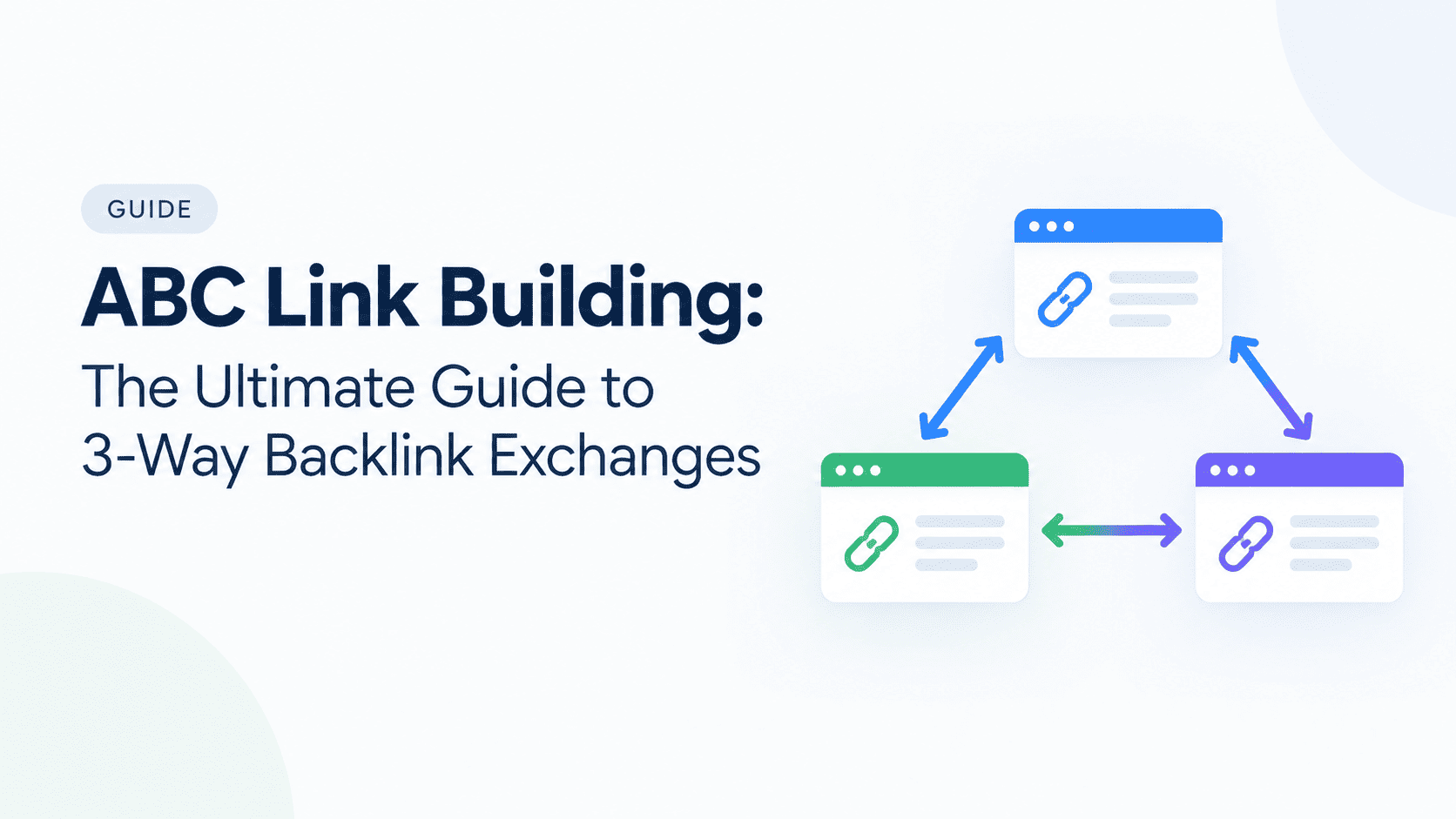


In the B2B SaaS industry, organic search is often the single most profitable acquisition channel. However, ranking for high-intent commercial keywords—like "best CRM software" or "project management tools"—requires significant domain authority.
Because software feature pages and pricing tables rarely earn links on their own, B2B companies need a proactive SaaS link building strategy to systematically build authority and outrank competitors.
Why SaaS Link Building Requires a Unique Approach
Generic link building strategies often fail when applied to software brands. SaaS SEO differs in three fundamental ways:
High Customer Lifetime Value (LTV): A single enterprise SaaS customer can be worth tens of thousands of dollars, justifying a higher investment in acquiring premium, highly relevant backlinks.
Commercial Intent Competition: You aren't competing against casual blogs; you are competing against heavily funded software giants and high-DR review aggregators.
Unlinkable Commercial Assets: External sites rarely link to raw pricing pages or product demos editorially without structured partnership incentive.
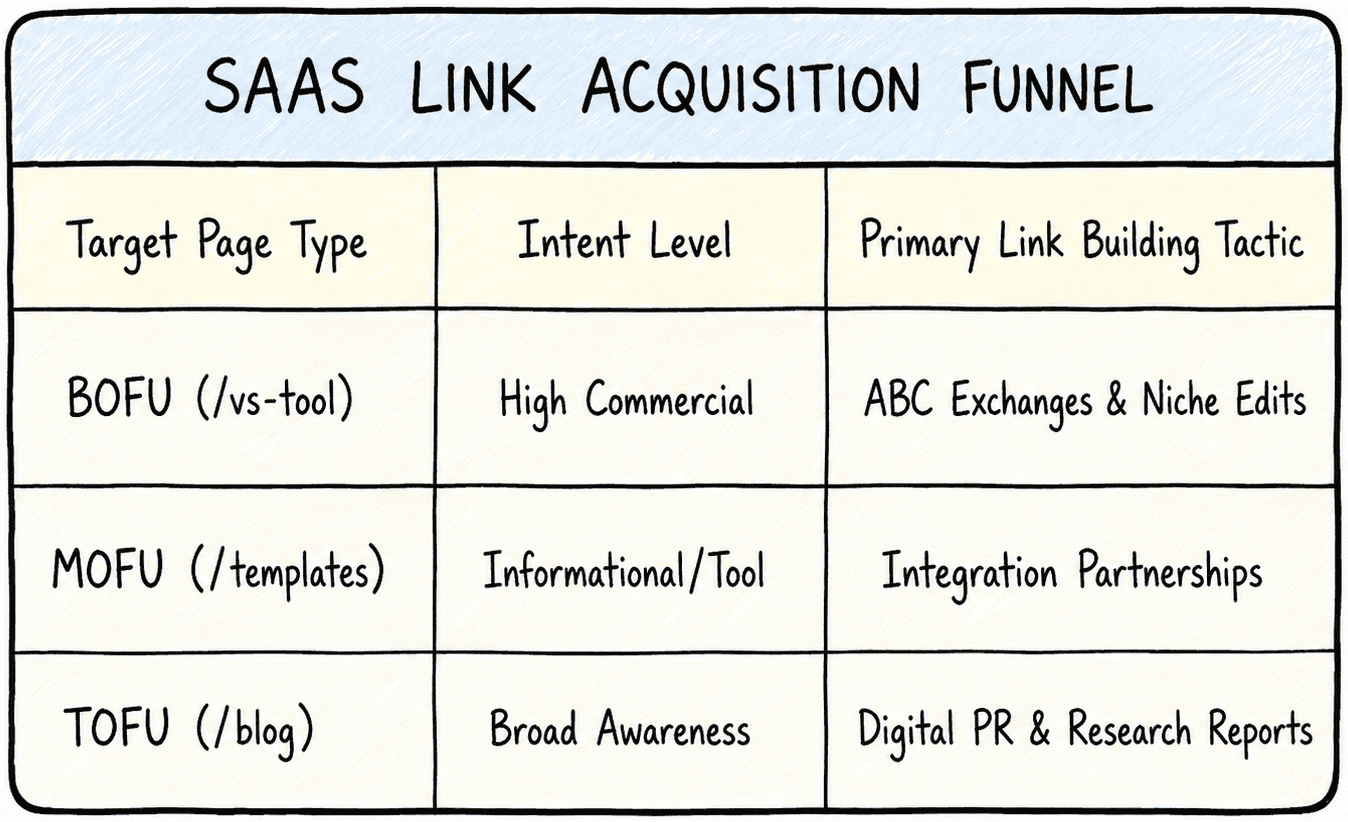
SaaS link acquisition funnel diagram showing how different page types, intent levels, and link building tactics align across BOFU, MOFU, and TOFU content.
Good to know
SaaS link building usually works best when it aligns with the way software buyers research products. Commercial pages may convert well, but they are often less naturally linkable than educational content, comparison pages, research assets, and practical tools.
- Do not expect pricing pages or demo pages to attract many editorial backlinks on their own.
- Build linkable supporting assets such as comparisons, templates, calculators, benchmark studies, and integration resources.
- Match link targets to search intent across awareness, consideration, and decision stages.
- Prioritize relevance and audience fit over raw authority metrics alone.
- Use content that helps buyers solve a problem, not just content that promotes the product.
- Support commercial pages indirectly by earning links to adjacent informational and middle-funnel assets.
- Diversify acquisition tactics rather than depending on one channel, one asset type, or one partner model.
Best strategy: linkable TOFU and MOFU assets + relevant placements + strong commercial-page support + diversified backlink acquisition.
The 3 Pillars of Scalable SaaS Link Acquisition
1. Integration-Led Partnerships
If your software integrates with other platforms, create dedicated integration pages. Reach out to partner companies to secure backlinks from their official app marketplaces or integration documentation pages.
2. Product-Led Assets & Free Tools
Develop free tools (e.g., ROI calculators, template generators, or baseline generators) that address specific user pain points. These assets naturally attract editorial citations from industry blogs and resource lists.
3. Non-Reciprocal ABC Link Exchanges
To get backlinks directly to hard-to-link commercial pages (like product comparison features), participate in 3-way (ABC) link exchanges.
By utilizing a triangular flow (A → B → C → A), you can trade contextual links with non-competing SaaS peers while keeping your link profile completely isolated from direct reciprocal footprints.
Good to know
Scalable SaaS link acquisition works best when each channel has an independent reason to exist. Integration pages, free tools, and partner content can earn links naturally, while coordinated exchanges require more scrutiny because their primary purpose may be promotional.
- Build integration pages that provide real setup, compatibility, or workflow information.
- Create free tools and templates that solve a clear user problem rather than serving only as link bait.
- Prioritize partner links that are useful to shared customers and audiences.
- Treat ABC exchanges as a higher-risk tactic, not a substitute for earned editorial links.
- Avoid describing triangular exchanges as “completely isolated” from search-engine detection.
- Review anchor text, topical relevance, and placement quality across every acquisition channel.
- Diversify link sources so growth does not depend too heavily on one partnership model.
Best strategy: useful integrations + genuinely linkable tools + relevant partnerships + cautious use of coordinated exchanges.
Evaluating SaaS Backlink Quality
Not all backlinks move the needle. Before accepting any link placement, ensure the referring domain passes a strict quality checklist:
Real Organic Traffic: Minimum 1,000+ monthly search visitors verified via Ahrefs or Semrush.
Topical Alignment: The site covers software, marketing, technology, or business operations.
Clean Spam Metrics: Moz Spam Score strictly below 5%.
Natural Anchor Placement: The link is embedded contextually within the body text of a relevant article.
Good to know
Backlink quality cannot be reduced to a single authority score or traffic cutoff. Third-party SEO metrics are useful screening tools, but they are estimates and should be weighed alongside relevance, editorial standards, and the quality of the linking page.
- Prioritize topical relevance between the referring site, linking page, and destination page.
- Review whether the site publishes original, useful content rather than thin or mass-produced pages.
- Use organic traffic estimates as a directional signal, not a universal pass/fail threshold.
- Treat metrics such as Moz Spam Score as supporting indicators rather than definitive measures of link quality.
- Favor contextual links placed naturally within relevant editorial content.
- Check whether the referring page is indexable, maintained, and capable of attracting real users.
- Evaluate the site’s overall outbound-link behavior for signs of excessive paid or manipulative placements.
Best strategy: topical relevance + real editorial quality + contextual placement + multiple quality signals.
Scaling Your SaaS Link Operations
While manual outreach and partnership management can work at a small scale, managing hundreds of SaaS link relationships manually quickly leads to broken agreements and spreadsheet chaos.
Using an automated platform like BacklinkExchange.org allows SaaS marketing teams to streamline 3-way link trades with vetted software partners, ensuring consistent monthly link velocity while protecting domain safety.
For a complete breakdown of multi-node exchange mechanics, refer to our core guide: