

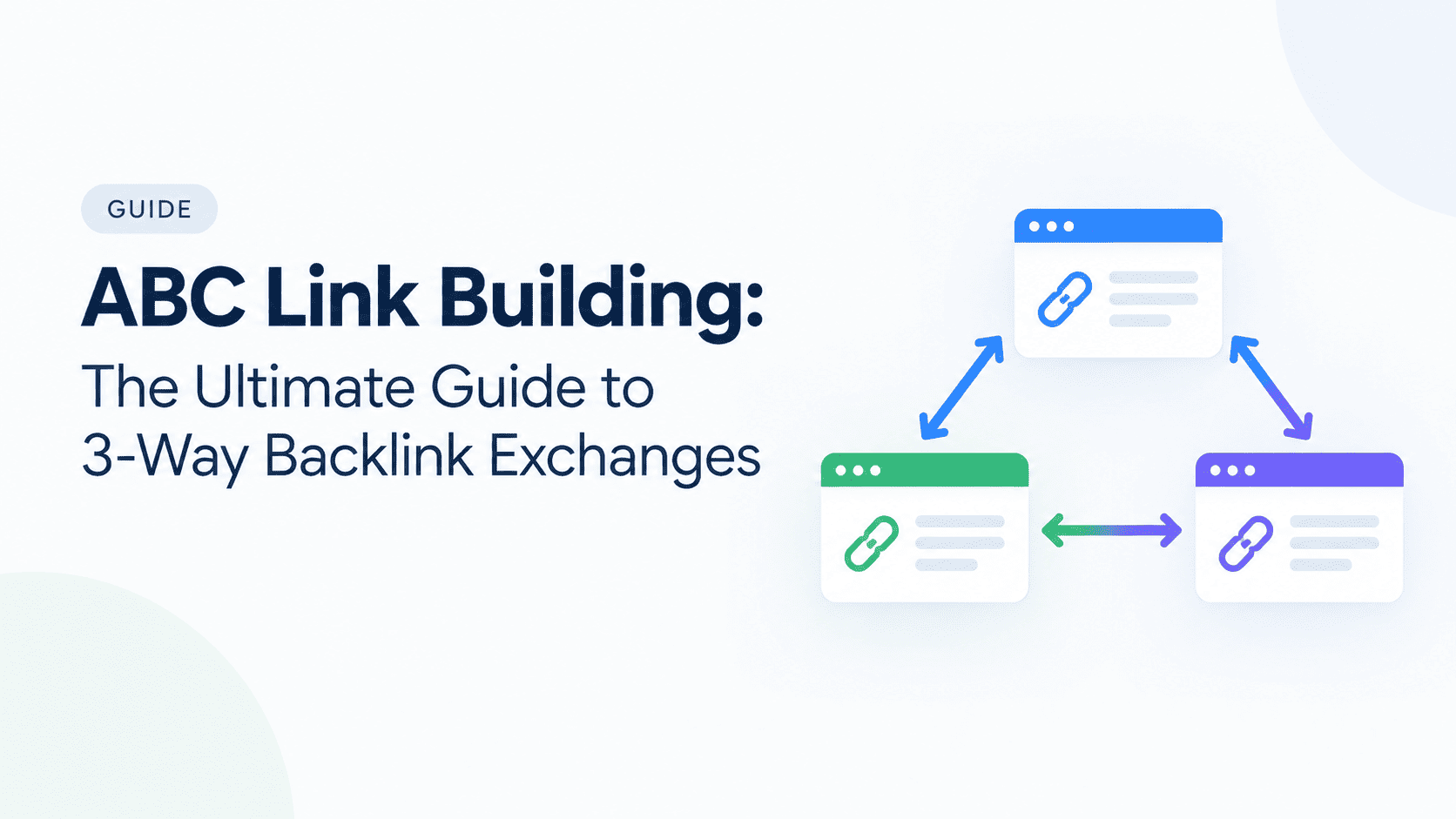


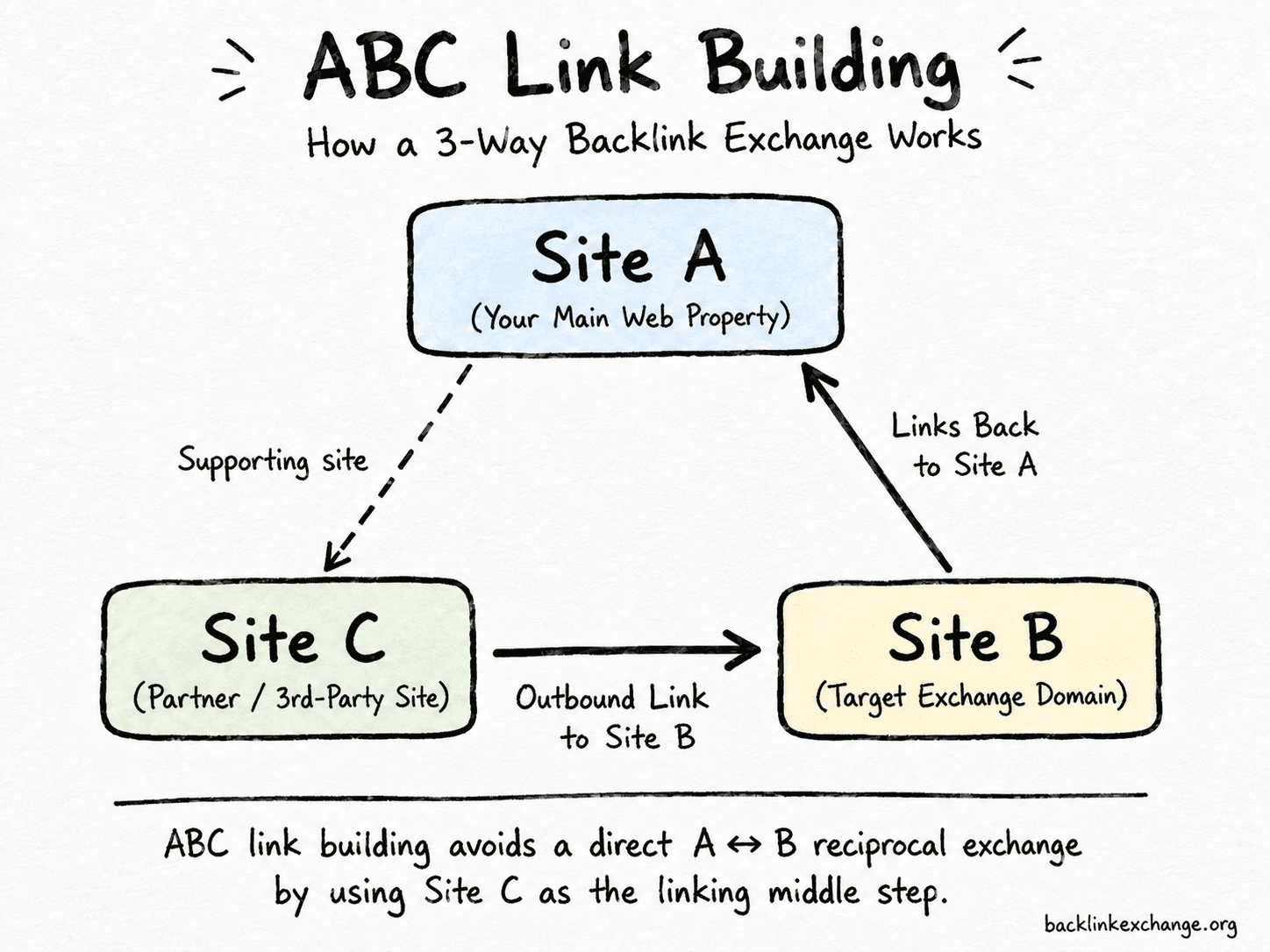
ABC link building is a three-site link arrangement: Site A links to Site B, Site B links to Site C, and Site C links to Site A. It removes direct A↔B reciprocity, but it does not make a coordinated arrangement automatically editorial, compliant, or valuable.
What is ABC link building?
In an ABC, or three-way, exchange, the three placements form A → B → C → A. The structure differs from a direct reciprocal exchange because no two sites link straight back to each other. That structural difference alone says nothing about the reason for the links, the quality of the pages, or how Google will treat them.
Are three-way exchanges safe or Google-compliant?
No exchange structure is automatically safe or Google-compliant. Google’s spam policies identify links created primarily to manipulate rankings, including excessive link exchanges and automated link-creation programs or services, as link spam. Purpose, scale, relevance, compensation, disclosure, and the wider pattern all matter.
Legitimate reciprocal links can occur when two related resources independently help readers. An indirect arrangement does not turn links created principally to influence rankings into editorial recommendations.
Direct reciprocal versus three-way links
| Question | Direct exchange | Three-way exchange |
|---|---|---|
| Structure | A ↔ B | A → B → C → A |
| Direct reciprocity | Present | Absent between a pair |
| Automatic ranking value or compliance | No | No |
| What to review | Editorial purpose, audience fit, context, disclosure, and the broader pattern. |
For the detailed decision table, compare direct reciprocal and three-way exchanges.
When to decline an exchange
- The audience or topic is irrelevant.
- The placement is forced into thin or low-quality content.
- Compensation is involved but the link will not be appropriately qualified.
- The same small group of partners appears repeatedly.
- The placement has no plausible referral value for readers.
- You are pressured to use artificial, repeated commercial anchor text.
How to evaluate a proposed placement
Start with the page, not a metric. Is the source useful, maintained, topically relevant, and written for an audience that could genuinely benefit from the destination? Does the surrounding copy explain why the resource belongs there? Are the publisher’s standards durable?
Domain Rating, Domain Authority, estimated traffic, and third-party spam metrics can be screening inputs, but they are estimates—not proof of quality, a Google threshold, or a guarantee of an outcome. Google does not publish a universal safe link-exchange threshold.
Practical coordination and monitoring
Maintain a record of the source page, destination page, surrounding context, intended audience, link attribute, publication status, and review date. Revisit placements periodically for removals, redirects, major context changes, or changed attributes. This is quality control, not a method for concealing coordinated activity.
For paid or otherwise compensated links, Google recommends rel="sponsored" or nofollow. Link attributes are treated as hints; an unqualified link does not guarantee that ranking signals will be used. See Google’s guidance on crawlable links and link attributes.
Anchor text and repeated patterns
Use descriptions that help readers understand the destination. Do not force a campaign to meet a fixed percentage. Google publishes no universal safe anchor-text ratio; a pattern across referring domains, pages, and placements is more informative than one anchor. Learn how to audit your anchor-text distribution, and review how repeated link patterns are evaluated as possible risk indicators rather than a published detection checklist.
Alternatives to exchanges
Build links and awareness with work that has an independent reason to be cited: original research, useful tools and templates, co-marketing, digital PR, well-maintained resource pages, and relationship-led contributions. A diversified acquisition strategy reduces dependence on any one tactic.