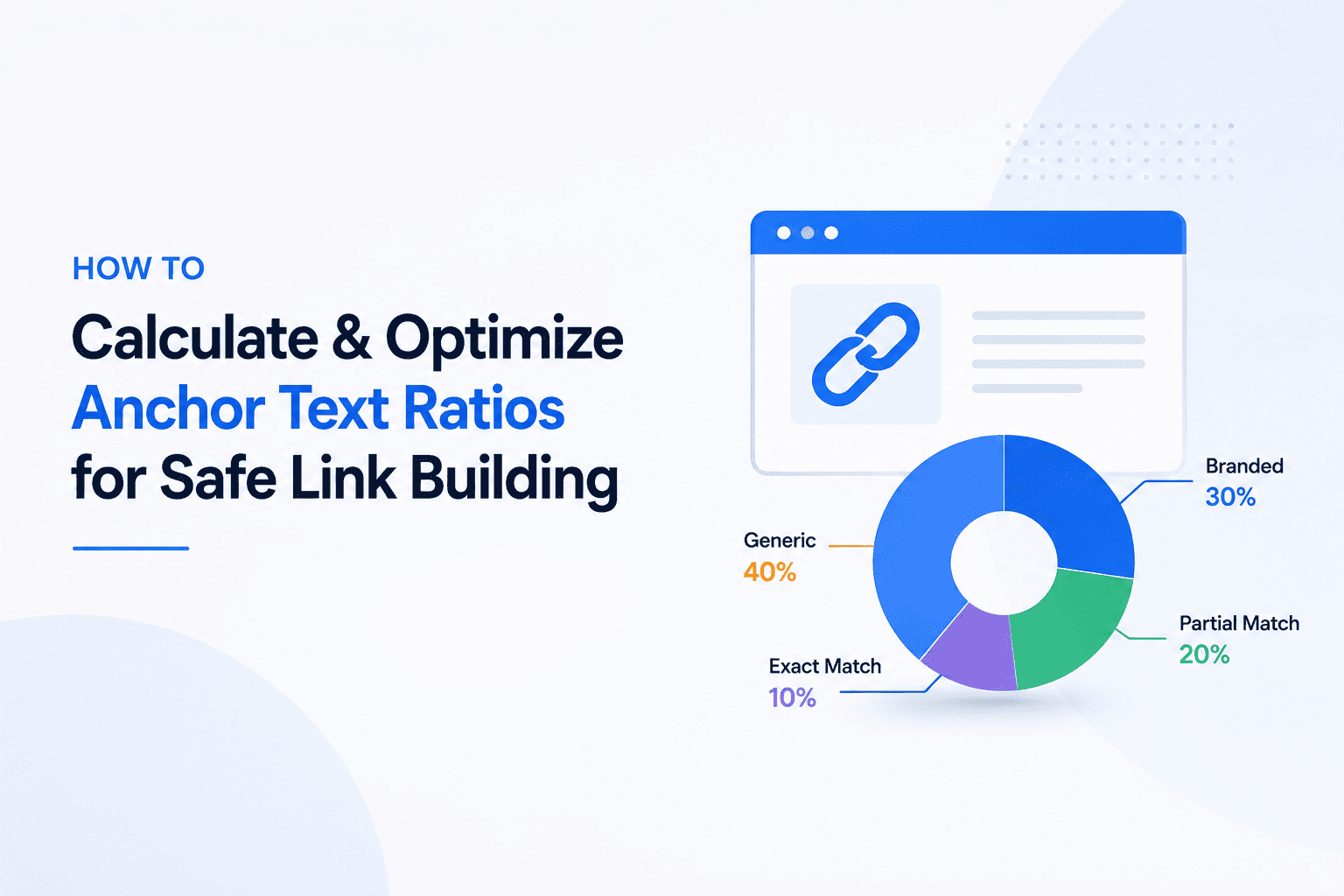
Acquiring high-authority backlinks is vital for driving organic keyword rankings. However, the clickable text carrying those links—known as anchor text—plays an equally important role in determining how search engines evaluate your off-page profile.

While anchor text tells search crawlers what your page is about, over-optimizing it with commercial keywords is one of the fastest ways to trigger search engine spam filters.

This guide breaks down how to classify anchor types, calculate your domain's anchor text ratios, and optimize your backlink profile for maximum ranking impact without risking over-optimization penalties.

Anchor text is only one part of building a safer backlink profile. The structure of the exchange itself also matters, especially when links move across multiple websites. For a broader look at how this works, see our guide to ABC link building and 3-way backlink exchanges:

ABC Link Building infographic showing how 3-way backlink exchanges work between Site A, Site B, and Site C, from the ultimate 2026 guide to ABC link building.Related article · 30 Aug 2026ABC Link Building: The Ultimate Guide to 3-Way Backlink ExchangesABC link building—commonly referred to as a 3-way or triangular backlink exchange—is an advanced off-page search engine optimization (SEO) strategy designed to pass…Read related article

What is an Anchor Text Ratio?

An anchor text ratio represents the percentage distribution of various anchor text categories across all unique referring domains pointing to a specific page or website.

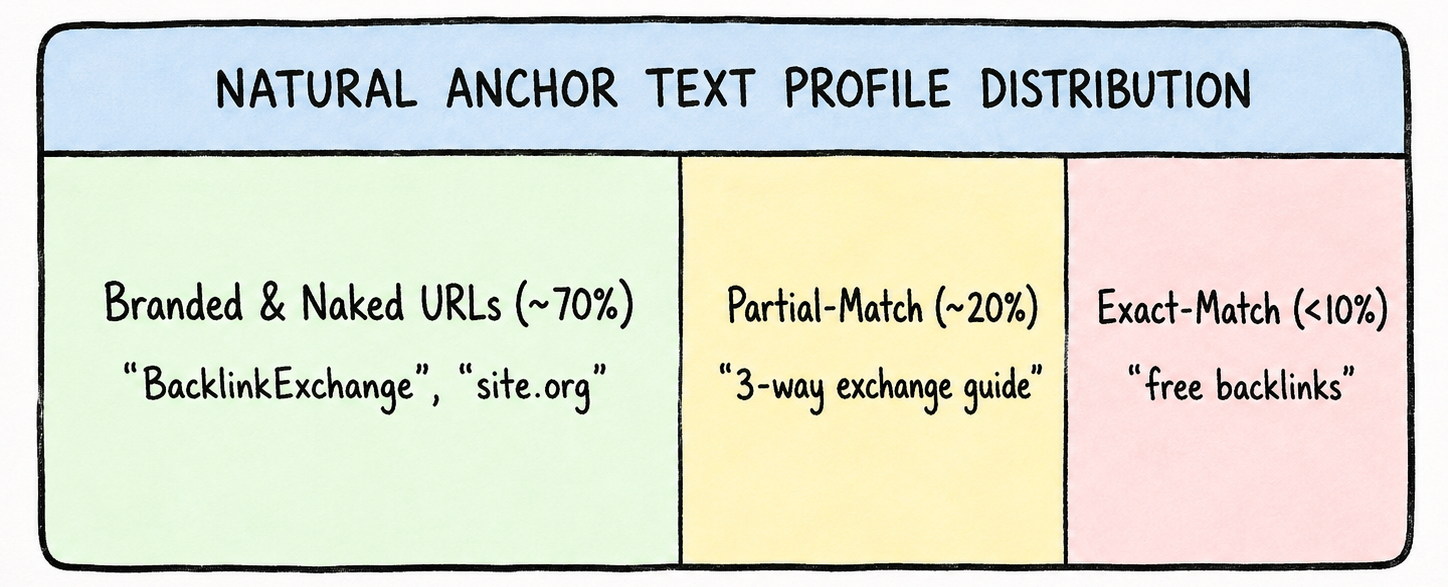
Anchor text ratio diagram showing a natural anchor text profile distribution with branded and naked URLs at around 70%, partial-match anchors at about 20%, and exact-match anchors under 10%.
Search algorithms analyze anchor distributions to detect unnatural link acquisition. A healthy, editorially earned backlink profile naturally features a high proportion of brand names and raw website addresses, with commercial search queries appearing sparingly.

The 5 Core Anchor Text Categories

To audit your backlink profile accurately, you must categorize incoming links into five distinct anchor types:

Anchor CategoryDescriptionExampleTarget Ratio Benchmark
BrandedContains your brand or company name."BacklinkExchange"50% – 60%
Naked URLRaw website address or target path.backlinkexchange.org15% – 20%
Partial-MatchMix of target keywords and natural text."guide to 3-way link building"15% – 20%
Exact-MatchIdentical commercial target keyword."ABC link building"< 10%
GenericNon-descriptive navigational text."click here", "read source"5% – 10%

How to Calculate Your Anchor Text Ratio

Calculating your anchor text ratios requires analyzing unique referring domains rather than total individual links, as sitewide footers or sidebar links can distort your data.

The Calculation Formula

Anchor Ratio % = (Unique Referring Domains in Category / Total Unique Referring Domains) * 100

Practical Example

If your target landing page has 50 unique referring domains:

  • 28 domains use Branded anchors → (28 / 50) x 100 = 56%

  • 10 domains use Naked URLs → (10 / 50) x 100 = 20%

  • 8 domains use Partial-Match anchors → (8 / 50) x 100 = 6%

  • 4 domains use Exact-Match anchors → (4 / 50) x 100 = 8%

In this scenario, the exact-match ratio (8%) sits comfortably under the 10% threshold, maintaining a safe, natural anchor profile.

The Danger of Over-Optimization Penalties

When Google introduced the Penguin algorithm update (now embedded directly into core search ranking systems), its primary target was over-optimized anchor text profiles.

When search crawlers detect an exact-match keyword ratio exceeding 15%–20%, two primary actions occur:

  1. Link Equity Neutralization: Systems like Google SpamBrain flag the incoming links as artificial trades, stripping them of PageRank equity.

  2. Keyword Rank Suppression: The target page may experience sudden drops in keyword rankings specifically for the over-optimized commercial queries.

Strategies to Rebalance an Over-Optimized Profile

If an audit reveals that your exact-match anchor text ratio exceeds safe limits, avoid deleting existing backlinks whenever possible, as this can destroy domain authority. Instead, apply the Dilution Strategy:

  1. Launch a Branded Link Campaign: Focus upcoming link acquisition efforts entirely on branded anchors and bare URL formats.

  2. Leverage Partial-Match Long-Tail Variations: Replace rigid target keywords with natural, multi-word descriptive phrases in upcoming guest posts or trades.

  3. Use Multi-Node 3-Way Exchange Networks: When building non-reciprocal links through platforms like BacklinkExchange.org, instruct partner sites to anchor your links using article titles or branded variations.