



Link footprint detection is a useful way to describe recurring patterns across links, publishing, or site relationships. It is not a public Google checklist, and it should not be approached as a way to make coordinated links harder to review.
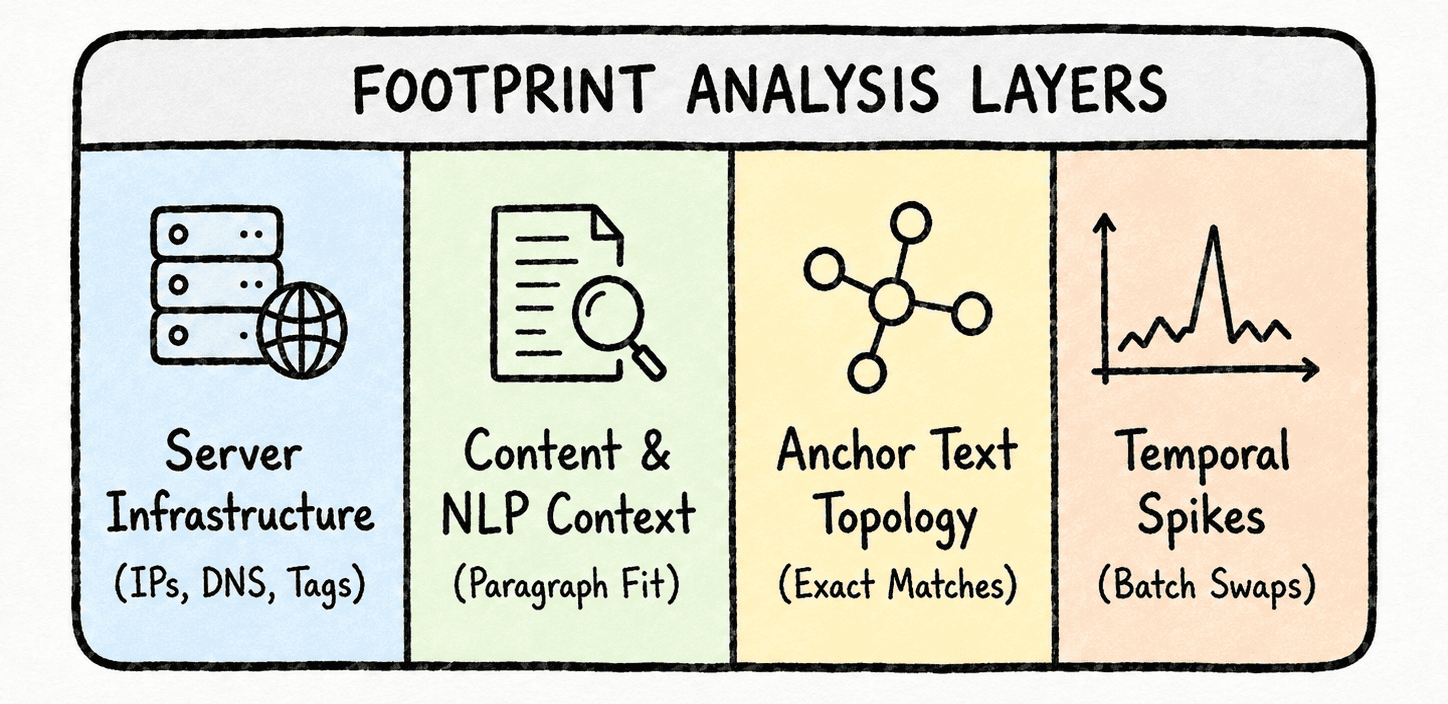
What a link footprint is
A footprint is a recurring feature that can invite closer review: repeated partners, templated placements, irrelevant context, repeated commercial anchors, or closely coordinated publishing. A single feature does not establish manipulation. The relevant question is whether each link is editorially useful, transparent, and defensible on its own.
What Google publishes
Google’s spam policies prohibit links created primarily to manipulate rankings, including excessive exchanges and automated services that create links. Google does not publish a full technical checklist for evaluating “footprints,” nor universal safe thresholds for IP addresses, anchor text, or timing.
Patterns worth reviewing
| Pattern | Why it may merit review | Better question |
|---|---|---|
| Repeated partners or templates | May indicate scaled coordination | Would this placement still help the reader without an agreement? |
| Irrelevant surrounding copy | Weakens editorial rationale | Does the destination genuinely support the page’s topic? |
| Commercial or paid relationship | May require disclosure and qualification | Is it clearly disclosed and appropriately qualified? |
| Shared infrastructure | Can have ordinary operational reasons | What does the broader content and linking pattern show? |
How to respond responsibly
Use pattern review for quality control, not concealment. Document the source page, destination, context, editorial rationale, relevant relationship, link attribute, and review date. For paid or sponsored placements, follow applicable advertising rules and Google’s outbound-link qualification guidance.
Direct and three-way arrangements
A direct exchange is A ↔ B; a three-way arrangement is A → B → C → A. Removing direct reciprocity changes the visible structure but does not make a coordinated link automatically editorial, compliant, undetectable, or valuable. Compare the structures in our 2-way versus 3-way guide, and use the ABC link-building guide for a policy-first decision framework.
Alternatives with independent value
Original research, useful tools, templates, resource pages, digital PR, and genuine editorial partnerships give people a reason to cite your work without relying on engineered patterns. Review your anchor-text distribution as a descriptive audit, not as a percentage to force.