

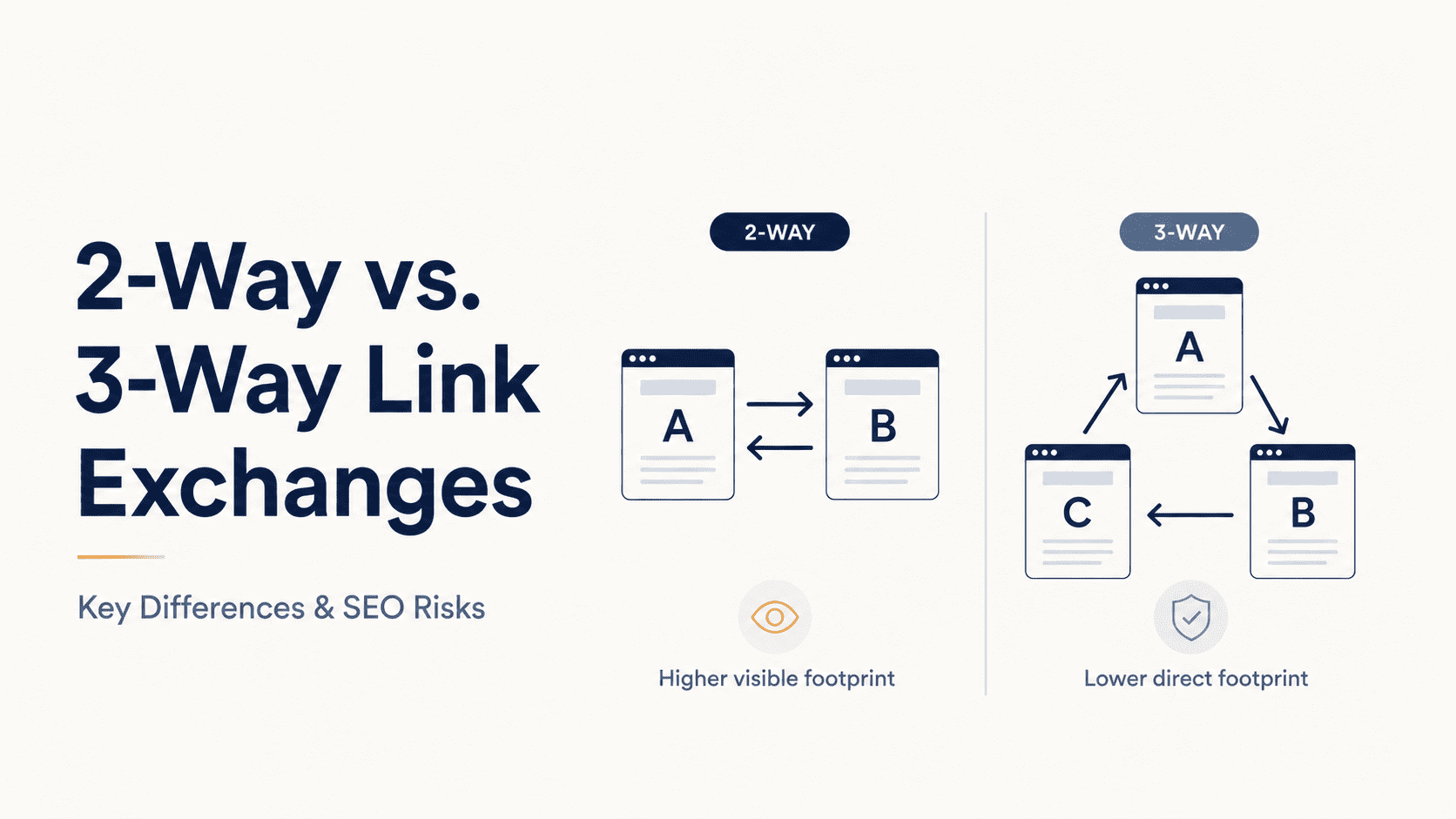
Building high-authority backlinks is one of the most effective ways to grow organic search traffic. However, how you structure your link partnerships determines whether those links pass valuable PageRank equity or trigger search engine spam filters.

Webmasters generally choose between two primary collaborative models: 2-way direct reciprocal exchanges and 3-way (ABC) non-reciprocal exchanges.

This guide breaks down the core differences, algorithmic risks, and strategic advantages of each approach.

If you want a deeper explanation of the three-site model, including how the A-to-B, B-to-C, and C-to-A structure works in practice, read our complete guide to 3-way backlink exchanges and ABC link building:

ABC Link Building infographic showing how 3-way backlink exchanges work between Site A, Site B, and Site C, from the ultimate 2026 guide to ABC link building.Related article · 30 Aug 2026ABC Link Building: The Ultimate Guide to 3-Way Backlink ExchangesABC link building—commonly referred to as a 3-way or triangular backlink exchange—is an advanced off-page search engine optimization (SEO) strategy designed to pass…Read related article

A 2-way link exchange (also known as a direct reciprocal swap) occurs when two webmasters agree to link directly to each other's websites.

  • Website A places an outbound link to Website B

  • Website B places an outbound link back to Website A

2-way link exchange diagram showing Website A and Website B linking to each other through an outbound link and a reciprocal backlink.

The Problem with 2-Way Swaps

While 2-way exchanges are simple to coordinate, they create a 100% direct reciprocal footprint. Search crawlers map link graphs continuously; when an algorithm identifies a direct mutual loop (A ↔ B), it recognizes an artificial trade and neutralizes the link equity passed between the domains.

Good to know

A reciprocal link is not inherently a penalty trigger. Websites naturally link to each other for legitimate editorial reasons, but repeated or coordinated exchanges designed primarily to manipulate rankings can become a problem.

  • Judge reciprocal links by relevance and editorial value, not simply by whether both sites link to each other.
  • Avoid large-scale “you link to me, I link to you” arrangements across unrelated websites.
  • Keep anchor text natural rather than forcing keyword-rich phrases into exchanged links.
  • Do not build reciprocal links solely to increase backlink counts or perceived authority.
  • Prioritize links that genuinely help readers discover useful, related information.
  • Watch for patterns involving the same partners, templates, or repeated commercial anchor text.
  • Treat reciprocal linking as an occasional editorial outcome rather than a standalone link-building strategy.

Best strategy: editorial relevance + natural linking + varied backlink sources + no systematic exchange footprint.

A 3-way link exchange introduces a third domain into the transaction, transforming a direct reciprocal loop into an isolated, triangular chain.

  • Website A links to Website B

  • Website B links to Website C

  • Website C links back to Website A


What is a 3-Way (ABC) Link Exchange?
Because no two domains directly trade links, each connection appears to search algorithms as an independent, one-way editorial citation.

2-Way vs. 3-Way Exchanges: Direct Comparison

Feature / Metric2-Way Link Exchange (A↔B)3-Way Link Exchange (A→B→C→A)
Link RelationshipDirect Reciprocal LoopTriangular Non-Reciprocal Chain
Footprint VisibilityHigh (100% visible to crawlers)Zero Direct Footprint
Search Engine RiskHigh (Flagged under link scheme policies)Low (Appears as organic editorial links)
PageRank TransferNeutralized / DiscountedFull Equity Transfer
Setup ComplexityEasy (2 partners)Moderate to High (Requires 3+ partners or automation)
ScalabilityDangerous at scaleSafe to scale across diverse networks

Good to know

A 3-way link exchange changes the visible link pattern, but it does not automatically make the arrangement safer. Search engines can evaluate broader link relationships, topical relevance, ownership signals, and repeated exchange patterns across multiple domains.

  • Do not assume an A → B → C → A structure is invisible to search algorithms.
  • Evaluate whether each link makes sense independently for the reader.
  • Avoid repeated triangular exchanges involving the same network of websites.
  • Keep anchor text natural and contextually relevant.
  • Be cautious when one party controls or routinely supplies the third domain.
  • Prioritize genuine editorial links over arrangements created primarily to pass ranking signals.
  • Treat 3-way exchanges as carrying similar policy risk when their main purpose is manipulating search visibility.

Best strategy: independent editorial value + relevant links + natural anchor text + no engineered exchange network.

Algorithmic Risk Analysis: Why 2-Way Swaps Get Devalued

Google's Search Essentials explicitly state that "excessive link exchanges ('Link to me and I'll link to you')" are considered link schemes that violate webmaster guidelines.

Modern algorithms handle reciprocal links through three main mechanisms:

  1. Automatic Equity Neutralization: Systems like SpamBrain flag reciprocal pairs and assign them zero PageRank value. You lose the time and effort invested without getting penalized explicitly.

  2. Topical Relevance Scrutiny: If two sites in completely unrelated industries exchange links (e.g., a SaaS platform and a local dentist), search algorithms downgrade trust metrics for both domains.

  3. Pattern Recognition at Scale: A few natural reciprocal links are expected on the web. However, if reciprocal swaps account for more than 15-20% of your total backlink profile, your domain enters a high-risk algorithmic audit tier.

Good to know

Google explicitly classifies excessive reciprocal linking done for ranking purposes as link spam, but it does not publish a fixed percentage at which reciprocal links become “unsafe.” Risk depends more on intent, scale, relevance, and the overall linking pattern than on a single backlink ratio.

  • A few natural reciprocal links are normal and are not automatically a problem.
  • Avoid systematic “link to me and I’ll link to you” arrangements created primarily to influence rankings.
  • Relevance matters, but unrelated links are not automatically a penalty signal on their own.
  • Google can use automated spam systems and manual review to identify manipulative linking practices.
  • Spammy links may lose any ranking benefit they previously provided rather than producing a visible manual penalty.
  • Do not rely on arbitrary reciprocal-link thresholds such as 15% or 20% unless they come from your own internal risk model.
  • Evaluate the broader backlink pattern, anchor text, partner quality, and editorial justification together.

Best strategy: natural reciprocity + genuine relevance + diversified backlinks + no large-scale exchange pattern.

Why 3-Way (ABC) Exchanges Win for SEO Growth

3-way exchanges overcome the structural vulnerabilities of 2-way swaps by leveraging footprint isolation:

  • Natural Referral Signals: Search crawlers view Website C linking to Website A as a standalone editorial recommendation.

  • Preserved Link Equity: Because the direct loop is broken, PageRank flows through the chain without getting flagged by reciprocal filtering algorithms.

  • Scalable Backlink Velocity: You can acquire dozens of high-authority backlinks each month safely, provided each link is embedded within contextually relevant content.

To learn how to structure an end-to-end 3-way link campaign, read our comprehensive main guide:

ABC Link Building infographic showing how 3-way backlink exchanges work between Site A, Site B, and Site C, from the ultimate 2026 guide to ABC link building.Related article · 30 Aug 2026ABC Link Building: The Ultimate Guide to 3-Way Backlink ExchangesABC link building—commonly referred to as a 3-way or triangular backlink exchange—is an advanced off-page search engine optimization (SEO) strategy designed to pass…Read related article

Good to know

A 3-way exchange removes direct reciprocity, but it does not automatically turn a coordinated link trade into an organic editorial backlink. Search engines can evaluate broader linking patterns, relationships between domains, anchor text, and the apparent purpose of the links.

  • Do not assume an A → B → C structure guarantees “footprint isolation.”
  • Evaluate whether every link would make sense even without an exchange agreement.
  • Avoid scaling coordinated exchanges simply because the links are not directly reciprocal.
  • Keep anchor text natural and avoid repeated commercial keyword patterns.
  • Be cautious when the same publishers, agencies, or domain networks appear repeatedly across exchanges.
  • Prioritize independently earned editorial links over engineered linking chains.
  • Treat 3-way exchanges as lower in visible reciprocity, not necessarily lower in policy risk.

Best strategy: independent editorial value + diverse referring domains + natural anchors + no scalable exchange network.

Manual Execution vs. Automated 3-Way Platforms

While 3-way exchanges offer clear ranking advantages, managing them manually via cold emails and spreadsheets creates significant operational friction:

  • Broken Agreements: If Website B fails to publish their link to Website C, the entire 3-way chain falls apart.

  • Time Overhead: Coordinating content, anchor text, and publishing dates across three independent webmasters takes hours per link.

The Automated Solution

Using an automated network like BacklinkExchange.org removes manual coordination completely. The platform matches your site with verified niche partners, programmatically constructs non-reciprocal ABC chains, and continuously checks live links to guarantee full equity flow.