

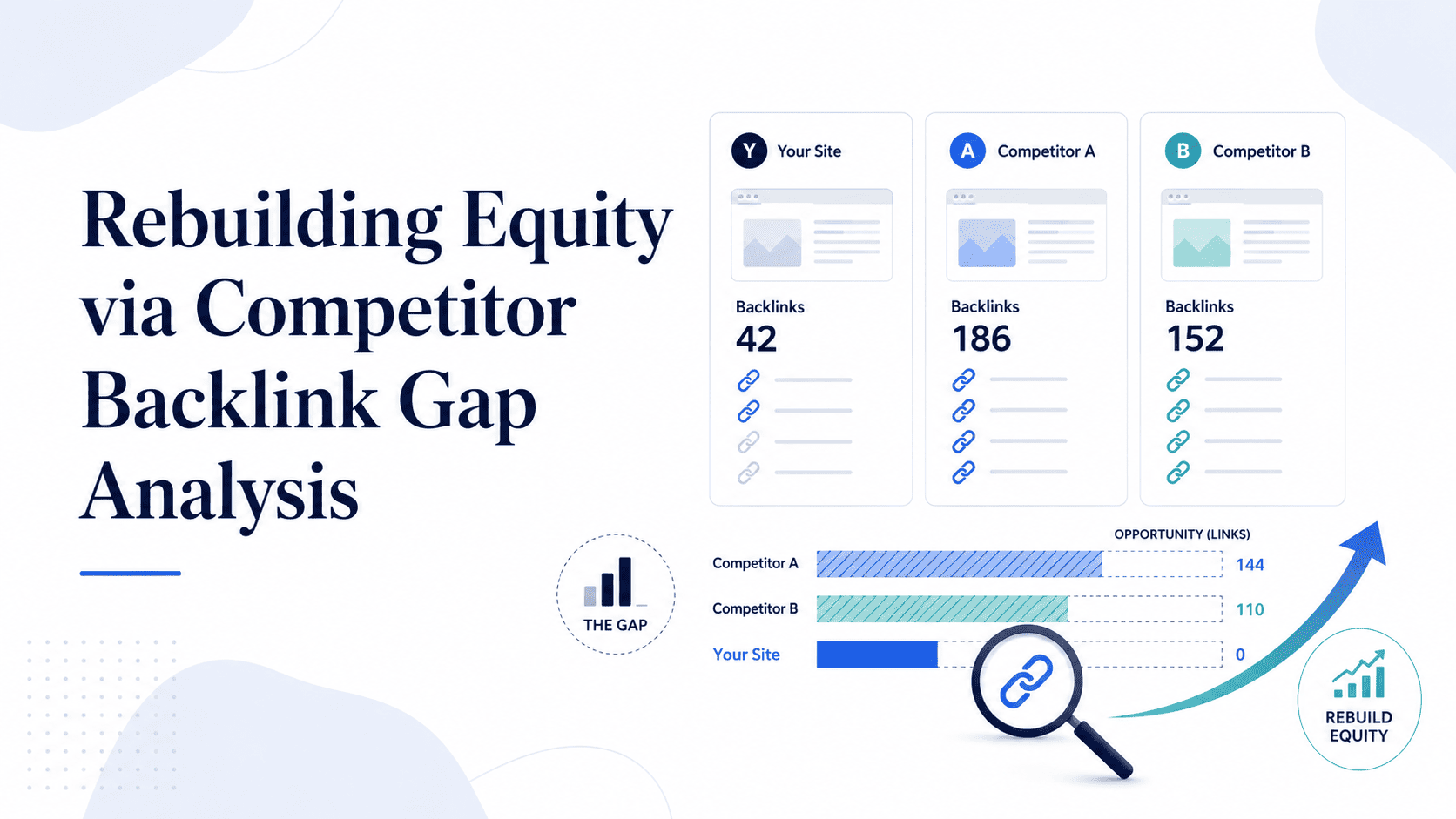


Building high-authority backlinks consistently requires targeting prospects that are already predisposed to linking to your niche. Reaching out blindly to unverified websites leads to low response rates and wasted outreach budgets.
Executing a competitor backlink gap analysis eliminates the guesswork by reverse-engineering your rivals' backlink profiles to identify high-converting "link intersections"—websites that link to multiple top-ranking competitors in your vertical, but not yet to you.
The Power of Link Intersections: Why Intersection Depth Matters
When analyzing backlink gaps, not all missing links carry equal value. Prioritize prospective referring domains based on their link intersection depth:
| Intersection Depth | Competitor Link Count | Opportunity Level |
|---|---|---|
| Single Link | Links to 1 Competitor | Low / Cold |
| Medium Gap | Links to 2 Competitors | Moderate |
| High-Value Hub | Links to 3+ Competitors | CRITICAL / HOT |
Single Competitor Links: The referring domain may have a personal relationship, paid arrangement, or isolated mention with that specific competitor.
Multi-Competitor Intersections (3+ Rivals): The referring domain functions as an active industry resource hub, roundup publisher, or vertical directory. Securing a link here is essential for ranking on page 1 for competitive keywords.
Good to know
Link intersection depth can help identify domains that repeatedly reference companies in your market, but overlap alone does not determine backlink value. A site linking to several competitors may be an important industry resource—or simply a directory, affiliate page, or paid-placement hub.
Prioritize domains that link to multiple relevant competitors and also show strong editorial quality.
Review the exact pages where competitor links appear, not just the referring domain.
Check whether the site functions as a genuine resource, publication, directory, or commercial link outlet.
Look for patterns in anchor text, placement type, and surrounding content.
Separate repeatable opportunities from links based on private partnerships or one-off mentions.
Do not assume a 3+ competitor intersection automatically makes a backlink high priority.
Combine intersection depth with relevance, traffic, indexing, and editorial standards before outreach.
Best strategy: competitor overlap + page-level review + topical relevance + realistic opportunity scoring.
Step-by-Step Execution: Reverse-Engineering Rival Equity
Follow this operational blueprint to extract, filter, and convert backlink gaps into live organic equity:
1. Extract Target Competitor Profiles
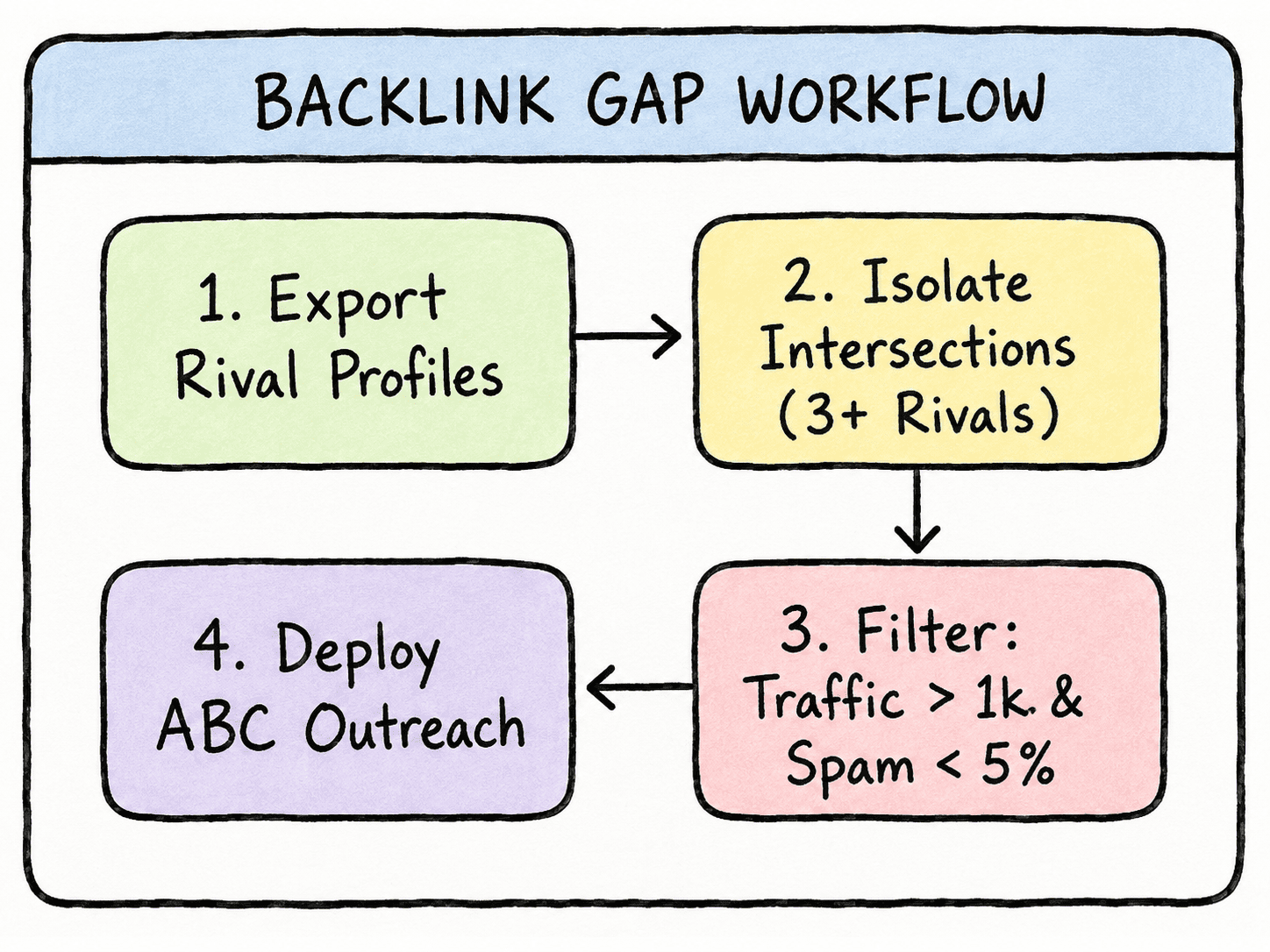
Identify 3 to 5 direct search competitors ranking above you for target terms. Export their full root domain backlink profiles alongside page-specific backlink reports for target money pages.
2. Apply Rigorous Quality & Traffic Filters
Do not replicate competitor web spam. Run the raw link gap list through strict domain filters:
Organic Search Traffic: Require at least 1,000+ monthly search visitors.
Spam Score: Ensure Moz Spam Score is strictly under 5%.
Indexation Check: Verify that the prospective linking page is actively indexed by Google.
For a deeper look into evaluating traffic trust over third-party scores, read our guide: Domain Rating vs. PageRank vs. Organic Traffic: How to Measure True Backlink Value.
3. Categorize Link Context & Match Asset Types
Review why the gap domain linked to your competitors. Common placement types include:
Resource Pages & Roundups: Requires a comprehensive, up-to-date guide or tool.
Unlinked Brand Mentions / Editorial Citation: Requires original stats, data points, or expert insights.
Product Review & Comparisons: Requires product trial access or partner integrations.
Good to know
Competitor backlink analysis is most useful when it explains the reason a link exists. The goal is not to copy every referring domain, but to identify repeatable opportunities that match your own content, product, and audience.
Analyze both domain-level and page-level competitor backlinks.
Review the exact linking page to understand why the competitor was cited.
Treat traffic and spam-score thresholds as screening benchmarks rather than universal rules.
Verify that the prospective page is active, relevant, and editorially credible.
Match your outreach asset to the original link context, such as a tool, guide, dataset, or comparison page.
Exclude placements that appear paid, automated, irrelevant, or impossible to replicate legitimately.
Prioritize opportunities where multiple competitors earned similar links for the same underlying reason.
Best strategy: competitor extraction + contextual analysis + quality screening + asset-to-opportunity matching.
Converting Gap Opportunities with Non-Reciprocal Exchanges
Once high-quality gap targets are isolated, standard cold outreach can still face low response rates. To increase conversion efficiency, combine gap outreach with non-reciprocal 3-way link trading:
3-Way (ABC) Link Topologies: Offer value to partner sites by providing contextual links from complementary network domains (A → B → C → A), bypassing reciprocal link footprints completely. Read our core pillar guide: ABC Link Building: The Ultimate Guide to 3-Way Backlink Exchanges.
B2B SaaS Alignment: Leverage product comparison assets and integration hubs to secure high-equity links: SaaS Link Building Strategy: How to Scale High-Authority Backlinks.
Quarterly Maintenance Routine: Maintain clean authority distributions with standard link cleanups: How to Perform a Backlink Audit: A Step-by-Step Guide for 2026.
Platforms like BacklinkExchange.org accelerate competitor gap conversion by connecting you directly with verified, traffic-backed site owners across your industry for secure 3-way link trades.